





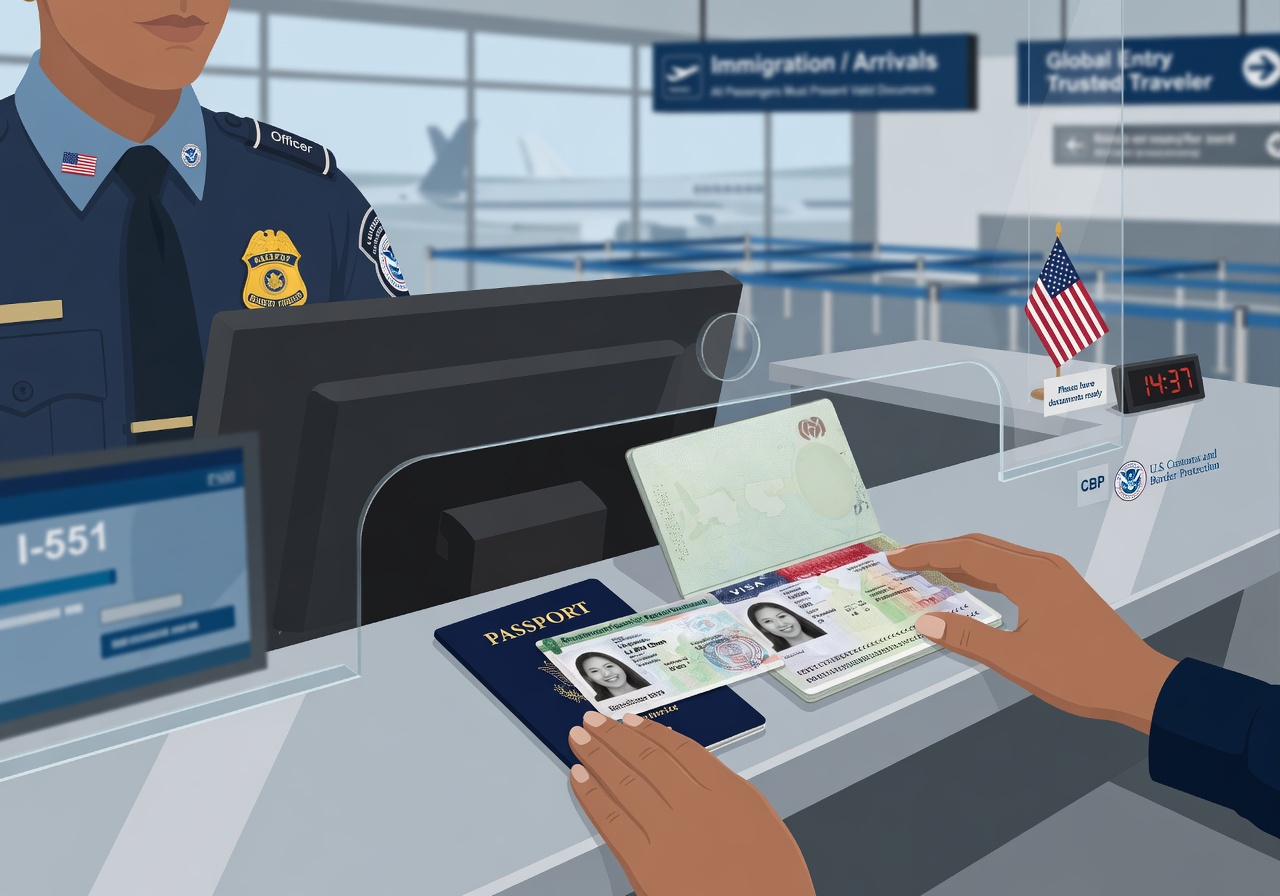
A green card is not a passport you can put in a drawer and forget about. It is proof that you live in the United States permanently. The moment your life starts looking like it is rooted somewhere else, that card stops protecting you, and a long trip abroad is the fastest way to make that happen.
Every year, lawful permanent residents come home from an extended stay overseas, hand a Customs and Border Protection officer their green card, and get pulled into secondary inspection instead of waved through. Some are handed a form to sign that quietly surrenders the status they spent years earning. This article explains exactly when time abroad becomes a legal problem, what the law actually says, and the concrete steps that keep your residence intact.
The Quick Answer
A trip abroad can cost you your green card. Under INA §101(a)(13)(C), an absence of more than 180 days makes you an "applicant for admission" — meaning you face every ground of inadmissibility when you return. A one-year absence creates a legal presumption of abandonment. What this means: protect yourself with a reentry permit before leaving, maintain strong U.S. ties, and never voluntarily sign Form I-407 at the border.
⚠️ Important
This article is for general educational purposes and is not legal advice. Abandonment cases turn on the specific facts of your trip and your ties to the U.S. If you are about to take a long trip, are already abroad, or were stopped at the border, talk to an immigration attorney before you act.
The Direct Answer: When Time Abroad Becomes Abandonment
Green card abandonment means giving up your lawful permanent resident (LPR) status, either on purpose or by acting in a way that shows you no longer intend to make the United States your permanent home. You do not have to sign anything to abandon it. The government can conclude you abandoned your status based on how you lived your life.
Time abroad is the single biggest red flag, and it works in three zones:
🟢 Under 6 months — Generally safe
A single trip of fewer than 180 days normally raises no presumption of abandonment. You should still be ready to show the trip was temporary, but a short trip alone is not a problem.
🟡 6 months to 1 year — The warning zone
An absence of more than 180 days (roughly six months) can make you an "applicant for admission" under the law, meaning the officer can scrutinize you as if you were arriving for the first time. It also breaks the continuous residence you need for citizenship.
🔴 1 year or more — The presumption of abandonment
An absence of one year or more makes your green card invalid as a travel document and creates a strong legal presumption that you abandoned your residence. Without a reentry permit or a returning resident visa, you may be refused boarding or placed in removal proceedings on return.
💡 Key Point
There is no magic number of days that is automatically "safe." Abandonment is about intent, not just a calendar. A person can abandon residence with a single 8-month trip if they moved their whole life abroad, while another can keep status through a 14-month absence if they had a reentry permit and strong ties. Time creates presumptions; intent decides the case.
What the Law Actually Says
INA §101(a)(13)(C) — The "Applicant for Admission" Trap
Under the Immigration and Nationality Act, a returning permanent resident is normally not treated as seeking admission to the country. That is the protection that lets you breeze through the border after a vacation. But INA §101(a)(13)(C) (codified at 8 U.S.C. §1101(a)(13)(C)) lists six situations that strip away that protection. The two that matter most for long trips are:
- You have been absent from the United States for a continuous period exceeding 180 days. Cross that line and CBP can treat you as an applicant for admission, opening the door to every ground of inadmissibility.
- You have abandoned or relinquished your LPR status. If the officer believes your conduct shows you gave up your residence, the same exposure applies regardless of the exact day count.
This is why the six-month mark is not arbitrary. It is the statutory tripwire that changes your legal posture from "resident coming home" to "person asking to be let in."
8 CFR §223 — The Reentry Permit
The regulations at 8 CFR §223 govern reentry permits and refugee travel documents. A reentry permit, requested on Form I-131, is the planning tool that protects residents who know they will be gone a long time. A valid reentry permit:
- Allows a permanent resident to remain outside the U.S. for up to two years without that absence, by itself, being treated as abandonment;
- Serves as the travel document for reentry in place of relying on the green card alone after a long absence; and
- Must be applied for while you are physically in the United States, and you must be present for biometrics (fingerprints) before you depart.
⚠️ A reentry permit is not a force field
A reentry permit rebuts the presumption that a long absence equals abandonment, but it does not guarantee admission. If the rest of your life shows you moved abroad permanently, an officer or judge can still find abandonment. The permit buys you protection and proves intent to return; it does not erase bad facts.
How the Government Decides Intent
Because abandonment is about intent, officers and immigration judges look past the calendar at the totality of your circumstances. The classic test asks whether your trip abroad was a temporary visit with a fixed end or an indefinite relocation. They weigh factors like:
- Purpose of the trip. Did you go for a defined reason (a job assignment, finishing a degree, caring for a sick parent) that had a foreseeable end, or did you just move?
- Whether you kept a home in the U.S. A maintained residence, lease, or mortgage is powerful evidence of intent to return.
- U.S. employment and finances. An active job, U.S. bank accounts, and bills in your name show your economic life stayed here.
- Tax filings. Filing U.S. taxes as a resident is one of the strongest signs of continued residence. Filing as a non-resident — or not filing at all — is one of the most damaging.
- Family ties. Whether your spouse and children remained in the United States.
- Where your "center of life" sits. Driver's license, voter registration, membership in community and religious organizations, and mailing address all paint the picture.
A Real Example From Our Practice
"We recently counseled a permanent resident who flew home to care for her mother after a stroke. What she expected to be a two-month trip turned into thirteen months. When she landed at the airport, CBP pulled her into secondary inspection, told her the green card was 'no good' after a year away, and slid Form I-407 across the table for her to sign."
She called us before signing. The facts that saved her were not in dispute — they were simply never given a chance to be heard at the airport. She had kept her apartment in the U.S. the entire time, kept paying rent, filed her U.S. tax return as a resident while abroad, and her husband and teenage son never left the country. The trip had a clear, documentable, temporary purpose: a medical emergency in the family.
Because she refused to sign Form I-407 and requested a hearing before an immigration judge, she preserved her right to argue her case. We assembled the lease, the tax transcript, the employer letter holding her job, and her mother's hospital records, and presented them to show the absence was an involuntary, temporary visit abroad — not abandonment. She kept her green card. Had she signed at the counter, she would have surrendered status that an immigration judge ultimately agreed she never intended to give up.
💡 The lesson
The border officer is not the final word on whether you abandoned your status. Only an immigration judge can formally take your green card. Signing Form I-407 hands away the right to make your case. Almost no one should sign it without talking to a lawyer first.
Stopped at the Border or Pressured to Sign?
Do not surrender your green card before you understand your options. We can help you preserve your status.
Schedule a ConsultationWhat to Do Before a Long Trip: A Checklist
The best abandonment case is the one you never have to make. If you know you will be abroad for an extended period, take these steps before you leave:
- File Form I-131 for a reentry permit if your trip may approach or exceed one year. You must be in the U.S. to apply and to give biometrics, so build that into your schedule.
- Keep a U.S. address and home. Maintain a lease, mortgage, or a room at a relative's home with your name on the mail.
- File U.S. tax returns as a resident for every year you are abroad. Never file as a non-resident if you intend to keep your green card.
- Keep U.S. bank accounts open and active, with some recurring activity that shows ongoing financial life here.
- Hold onto a valid state driver's license or ID and keep your voter registration current where eligible.
- Get a letter from a U.S. employer if your trip is work-related, showing the assignment is temporary and your job awaits your return.
- Document the temporary purpose of the trip — medical records, school enrollment with a graduation date, a contract with an end date.
- Keep family in the U.S. when possible, or be ready to explain why everyone traveled together.
- Save evidence as you go. Do not wait until you are at the airport to gather proof. Keep a folder of bills, statements, and records.
What to Do at the Border When You Return
If you are stopped on reentry and an officer questions your time abroad, stay calm and remember these points:
- Be honest, but do not volunteer that you "moved" abroad. Explain the temporary purpose and your intent to return — truthfully.
- Present your evidence. If you have your tax transcripts, lease, or employer letter, show them.
- Do not sign Form I-407. You are not required to surrender your green card. Politely decline and ask to see an immigration judge.
- Ask for a Notice to Appear and a hearing if the officer insists you abandoned status. That puts the decision in front of a judge, where you can present a full case.
- Call an immigration attorney as soon as you can. Time and documentation matter.
⚠️ Already abroad with no permit?
If you are stuck outside the U.S. for over a year and never got a reentry permit, you are not necessarily out of options. You may be able to apply for an SB-1 returning resident visa at a U.S. consulate by showing your prolonged stay was caused by circumstances beyond your control. These applications are demanding and time-sensitive — get legal help before the consular interview.
Special Situations
Naturalization and the "Continuous Residence" Problem
Even if a trip does not cost you your green card, it can quietly reset your path to citizenship. For most applicants, an absence of six months or more breaks continuous residence for naturalization and can force you to wait longer to apply, while an absence of one year or more almost always restarts the clock. If U.S. citizenship is your goal, time your travel carefully and read our guide on the N-400 citizenship interview before you book a long trip.
Conditional Residents (Two-Year Green Cards)
If you hold a two-year conditional green card through marriage, long absences carry the same abandonment risk and can complicate the timing of your Form I-751 petition to remove conditions. Coordinate any extended travel around your filing window.
When Abandonment Leads to Removal Proceedings
If CBP refers you to an immigration judge on an abandonment charge, you are effectively defending your status in court. The good news is that the government bears the burden of proving abandonment by clear, unequivocal, and convincing evidence. The reality is that you still need to come prepared. If you are in this position, see our overview of how a green card holder can face deportation in 2026 and what defenses exist.
Common Myths That Get People in Trouble
- "As long as I come back once a year, I'm fine." Brief, token visits to the U.S. to "stamp" the card do not preserve residence if your real life is abroad. Officers see through it.
- "The officer can't take my green card unless I sign." Correct that they cannot strip your status on the spot — but if you sign Form I-407, you hand it over voluntarily. Many people sign under pressure without realizing it.
- "A reentry permit lets me stay away as long as I want." It covers up to two years and proves intent, but it is not unlimited and does not override evidence that you relocated.
- "I filed taxes, so I'm safe." Tax filings help enormously, but they are one factor. If you filed as a non-resident, you may have hurt yourself.
Get Legal Help Before You Travel — or Before You Sign Anything
Green card abandonment is one of the most preventable problems in immigration law and one of the hardest to fix after the fact. A short conversation before a long trip can save years of work. At Modern Law Group, we help permanent residents:
- Plan extended travel and file for travel documents and advance parole the right way;
- Respond when CBP challenges status at the airport and pressures a return resident to sign Form I-407;
- Build and present abandonment defenses before an immigration judge;
- Pursue SB-1 returning resident visas when a prolonged absence was unavoidable; and
- Time travel and filings to protect the path to family-based green cards and citizenship.
Frequently Asked Questions
There is no fixed number of days that is automatically safe. A single trip of fewer than six months generally raises no presumption of abandonment. A trip of six months to one year can trigger questions at the border and breaks the continuous residence needed for naturalization. A trip of one year or more creates a legal presumption that you abandoned your residence, and your green card is generally treated as invalid for reentry unless you obtained a reentry permit or returning resident visa.
The "6-month rule" refers to two things. First, under INA §101(a)(13)(C), an absence of more than 180 days (roughly six months) can cause a returning permanent resident to be treated as an applicant for admission, exposing them to grounds of inadmissibility. Second, an absence of six months or more breaks the continuous residence required for naturalization unless rebutted. A trip under six months is the safest zone, but your intent still matters.
Not by operation of law, but an absence of one year or more makes the green card invalid as a travel document for reentry and creates a strong presumption of abandonment. To return, you generally need a reentry permit obtained before the trip, an SB-1 returning resident visa, or you must convince a border officer or immigration judge that you never intended to abandon your residence. Only an immigration judge can formally find abandonment.
A reentry permit is a travel document, applied for on Form I-131 under 8 CFR §223, that lets a permanent resident stay outside the United States for up to two years without the long absence being treated as abandonment. You should apply for it before you leave, and you must be physically present in the U.S. to give biometrics. It is strongly recommended for anyone planning a trip likely to last close to or beyond one year.
A Customs and Border Protection officer cannot legally strip you of permanent resident status on the spot — only an immigration judge can formally find abandonment. However, officers can pressure returning residents to sign Form I-407, which is a voluntary surrender of the green card. You are not required to sign it. You have the right to refuse, request a hearing before an immigration judge, and consult an attorney.
Abandonment turns on intent, not just time. Strong evidence includes a U.S. tax return filed as a resident, an active U.S. bank account, a maintained home or lease, a U.S. job or employer letter, family remaining in the United States, a valid U.S. driver's license, and proof that the trip had a clear temporary purpose with a fixed end date. The more ties you kept, and the more the trip looks like a temporary visit abroad, the stronger your case.
Protect the Status You Worked For
Whether you are planning a long trip or fighting an abandonment charge, speak with an experienced immigration attorney about your situation.
Schedule a Consultation